Marketing technology rarely fails because a brand lacks tools. More often, it fails because the tools do not work together, ownership is unclear, and every regional exception adds another layer of complexity.
Chiefmartec's 2026 Marketing Technology Landscape counts 15,505 MarTech products, up just 0.79% from the previous year, a possible plateau after 15 years of expansion. But the near-flat total hides significant churn: 1,488 products were added while 1,367 were removed.[1] The challenge has shifted from simple proliferation to continuous change across a large and unstable vendor landscape.
Integration has not kept pace with that change. MuleSoft's 2026 Connectivity Benchmark reports that the average organization now manages 957 applications, while only 27% are connected.[2]
At the same time, marketing leaders are under pressure to create more value with limited resources. Gartner reported that marketing budgets rose only slightly to 7.8% of company revenue in 2026, from 7.7% in 2025, while 56% of surveyed CMOs said they lacked the budget required to deliver their 2026 strategy.[3]
For global brands, the answer lies in a deliberate MarTech stack architecture rather than another isolated platform. MarTech stack architecture is the way a brand's marketing technologies connect customer data, content, channels, workflows, and measurement, and who owns each part, while the whole system stays flexible enough to evolve.
A MarTech stack should be designed as a business system
A list of platforms is not an architecture.
Architecture defines how capabilities fit together, how data moves between them, who owns each decision, and what happens when a tool is replaced. It turns a collection of technologies into an operating system for marketing.
A practical way to structure MarTech architecture is through four connected capability layers:
- Experience and activation: websites, mobile applications, email, paid media, social, commerce, contact centers, and in-store touchpoints.
- Content and product intelligence: CMS, DAM, PIM, localization, rights management, and structured content.
- Customer data and identity: event collection, profiles, identity resolution, audiences, preferences, and consent.
- Decisioning and measurement: personalization, experimentation, analytics, attribution, AI, observability, and reporting.
The products within these layers will change, but the responsibilities should stay stable.
This capability-first approach makes technology decisions easier. Instead of asking, "Which platform should we buy?", teams can ask:
- Which business capability is missing or underperforming?
- Is the problem caused by technology, integration, process, or ownership?
- Can the existing stack support the use case?
- What would it cost to replace this component later?
These questions reduce duplicate investments and keep architecture tied to measurable outcomes.
Choosing the right architecture pattern
There is no universal blueprint for every global brand. The right pattern depends on the organization's scale, operating model, internal engineering capacity, speed requirements, and appetite for complexity.
Three patterns appear frequently in enterprise MarTech.
1. Suite-centered architecture
In a suite-centered model, one strategic platform provides several core capabilities, often CRM, customer data, orchestration, analytics, and activation. Specialist tools are connected around that platform.
Advantages
- Faster implementation when requirements align with native workflows.
- Fewer vendors and integration points to manage, with more consistent identity, permissions, and support.
- A simpler operating model for teams with limited engineering capacity.
Trade-offs
- Greater dependency on one vendor's roadmap and data model.
- Customization can become difficult to maintain.
- Replacing one capability may require changes across the suite.
- Regional requirements may not fit standardized global workflows.
A suite-centered approach is effective when simplicity and speed matter more than maximum flexibility. The risk is treating the suite as the automatic answer to every requirement.
2. Composable and headless architecture
Headless architecture separates the presentation layer from back-end services through APIs. A composable approach extends this principle by combining replaceable capabilities for content, commerce, search, customer data, and decisioning.
This gives experience teams more freedom to create for different channels without rebuilding the underlying business logic each time.
Advantages
- Faster front-end experimentation.
- Reusable content and services across websites, apps, kiosks, and emerging channels.
- The ability to select best-fit platforms for important capabilities.
- Easier replacement when components are separated by stable interfaces.
Trade-offs
- The brand becomes responsible for orchestration, preview, caching, and end-to-end reliability.
- Editorial workflows can become fragmented if the authoring experience is overlooked.
- Integration and platform-engineering costs appear earlier, and more vendors can mean more operational coordination.
Headless and composable architectures create value only when the organization can operate them effectively. Adopting them does not by itself make a stack modern or scalable.
3. Microservices and event-driven architecture
Microservices divide business capabilities into independently deployable services. Event-driven architecture allows systems to publish business events, such as ConsentUpdated, OrderCompleted, or AudienceQualified, for other systems to consume.
The two patterns are related but not identical. A brand can use events without turning every capability into a microservice.
Advantages
- High-change capabilities can be developed, scaled, and released independently, on their own schedules.
- Events support near-real-time customer journeys without tightly coupling every platform.
- Failures can be isolated when retries, queues, and idempotency are designed correctly.
Trade-offs
- Distributed systems are harder to test, monitor, and debug.
- Event and schema ownership can become unclear.
- Data may be temporarily inconsistent across systems.
- Operational overhead can outweigh the benefit for smaller teams.
Microservices should solve a clear organizational or scaling problem. A well-designed modular application is often a better foundation than a distributed system introduced too early.
The most practical answer is usually hybrid
Global enterprises rarely need to choose one pattern for the entire ecosystem.
A more sustainable model is often:
- A suite for standardized, commodity workflows.
- Headless boundaries where customer experiences change quickly.
- Event-driven integration where multiple systems need the same business facts.
- Microservices only where independent ownership, scaling, or release cycles justify them.
In a hybrid approach, each pattern is used where its benefits exceed its operational cost, rather than out of loyalty to one architectural style.
From architecture to implementation: NMQ Digital's development expertise
NMQ Digital's development specialists work with these patterns in client delivery, with hands-on experience in headless CMS architecture, reusable front-end engineering, custom API and system integration, and scalable cloud infrastructure built on auto-scaling AWS and Azure environments.
Our data and analytics teams also design event and data layers across web, mobile, and digital platforms, including server-side processing that validates, enriches, and routes events to analytics and activation systems. Our AI and automation capabilities extend this work to governed AI-enabled workflows, modern content delivery, reliable integrations, and multi-market digital platforms.
Before recommending a headless, cloud, event-driven, or microservice-based pattern, our engineers evaluate it against the business need, existing technology, operating capacity, security requirements, and long-term cost of ownership. This allows NMQ Digital to introduce modern development practices where they create measurable value without adding unnecessary complexity.
Integration is the load-bearing layer
Point-to-point connections may seem fast during an individual project. At enterprise scale, they create dependencies that are difficult to see and expensive to change.
A scalable MarTech stack uses shared integration standards:
- Describe HTTP interfaces with OpenAPI, and define versioning, pagination, rate limits, idempotency, and deprecation policies for every API contract.
- Give event contracts consistent naming, a common envelope such as CloudEvents, schema validation, compatibility rules, replay policies, and globally unique IDs.
- Secure identity and access with OAuth 2.0, OpenID Connect, short-lived credentials, least privilege, and centralized secrets management.
- Choose APIs, streams, change-data capture, or batch for data movement based on the business requirement, and treat "real time" as a defined service level rather than a default.
- Build observability with correlation IDs and vendor-neutral telemetry standards such as OpenTelemetry, so a transaction can be followed across internal services and external platforms.
An API gateway or integration platform can support these standards, but it cannot replace ownership. Every interface still needs an accountable producer, known consumers, a service-level objective, a data classification, and a retirement plan.
Customer data needs purpose, provenance, and consent
The phrase "single customer view" can be misleading. A global organization may need separate identifiers for a person, account, household, device, loyalty membership, and anonymous visitor. Combining them into one permanent identifier can produce false matches and unnecessary privacy risk.
A more reliable model begins with purpose:
- What decision will this data support?
- Which system is authoritative?
- How fresh must the data be?
- In which regions may it be processed?
- Which consent or legal basis applies?
- When must it be deleted?
Customer records and events should carry their source, timestamp, consent status, confidence, and transformation lineage. Durable facts should be separated from calculated attributes and predictions.
This foundation remains a major industry challenge. Salesforce's tenth State of Marketing report found that only 25% of marketers were satisfied with their customer data unification.[4] Better architecture makes data understandable, governed, and safely usable wherever it creates value, without forcing every dataset into one platform.
What AI-first development should mean for MarTech
AI is now part of everyday marketing operations. Salesforce's tenth State of Marketing report found that 75% of marketers use AI, even though many still struggle to move beyond one-way, generic campaigns.[4]
An AI feature added to an existing platform, however, falls short of an AI-first architecture.
AI-first development means designing workflows in which machines can assist, recommend, or automate while humans remain accountable. In MarTech, that can include:
- Content classification and metadata generation.
- Translation and localization drafts.
- Campaign and journey recommendations.
- Anomaly detection in marketing performance.
- Marketer copilots grounded in approved brand and product knowledge.
- Developer assistance for testing, mappings, and technical documentation.
The architecture around the model matters as much as the model itself. Enterprise implementations need:
- An approved model catalog and model gateway.
- Prompt and policy versioning.
- Retrieval from governed knowledge sources.
- Evaluation datasets for quality, safety, and bias.
- Controls for personal and confidential data.
- Human approval for consequential customer-facing actions.
- Monitoring for cost, latency, drift, and business impact.
Because models will change quickly, brand rules, customer permissions, and audit requirements should remain outside the model and under the organization's control.
Governance must be global and execution must remain local
Centralizing every architecture decision creates a bottleneck. Allowing every region to select its own platforms recreates fragmentation.
The practical middle ground is federated governance. Federated governance is a model in which a central group sets shared principles, standards, and reusable foundations, while domain and regional teams make decisions within them. In this model:
- A global architecture council defines principles, reference patterns, shared capabilities, and exception processes.
- Domain owners are accountable for areas such as customer data, content, commerce, activation, and measurement.
- Regional stewards translate local regulation, language, residency, and channel needs into controlled extensions.
- A platform engineering team provides reusable foundations for identity, delivery pipelines, observability, integrations, consent, and secure AI access.
- Portfolio governance reviews adoption, overlap, cost, risk, integration health, and exit options.
Done well, governance speeds up good decisions instead of adding meetings. Clear standards and reusable foundations allow local teams to move faster without sacrificing global consistency.
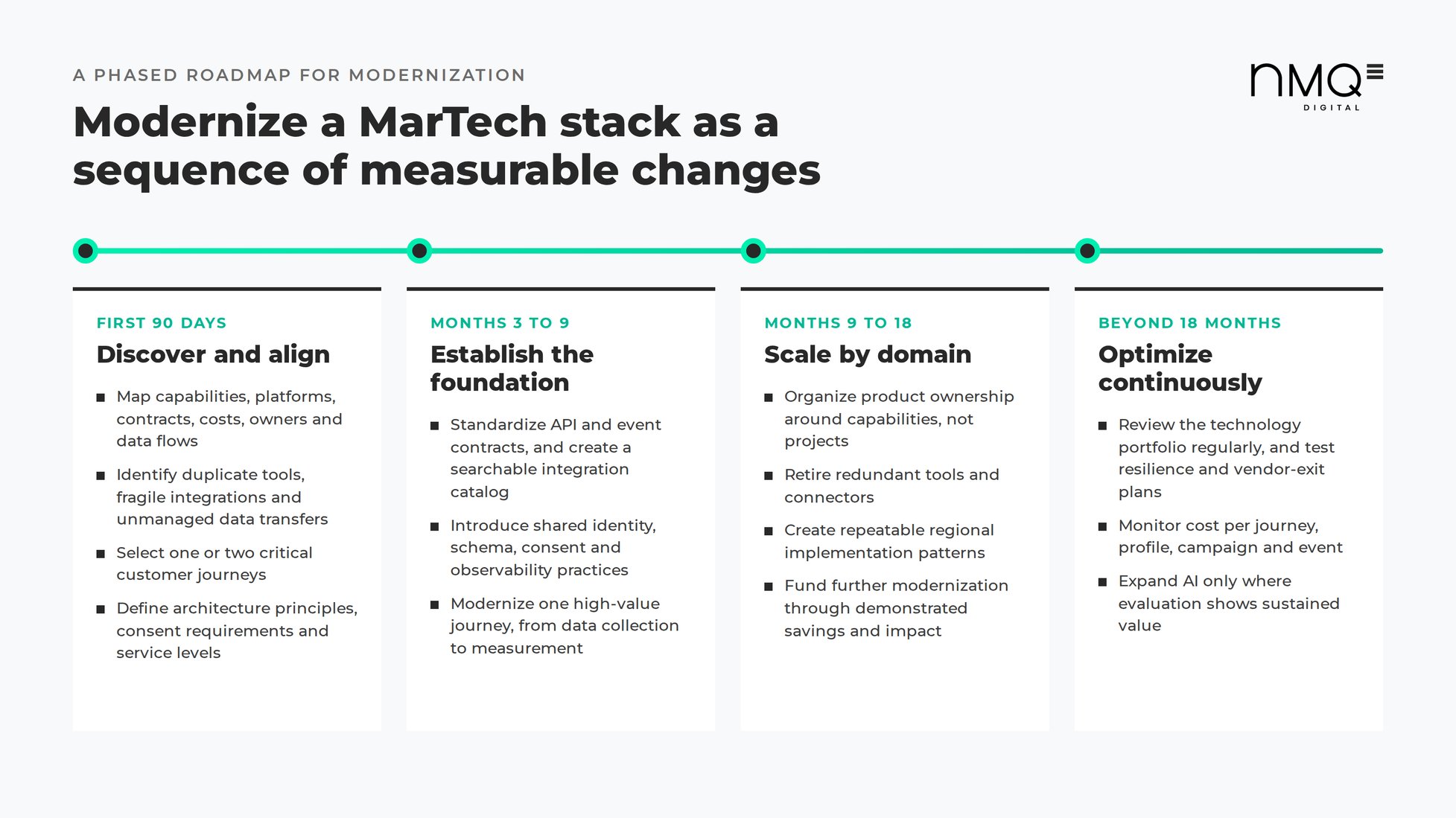
A phased roadmap for modernization
Trying to replace an entire MarTech ecosystem at once usually creates more risk than value. Modernization works better as a sequence of measurable changes.
Measure flow, not tool count
Reducing the number of platforms can be useful, but a smaller stack can still be slow, fragile, or difficult to govern.
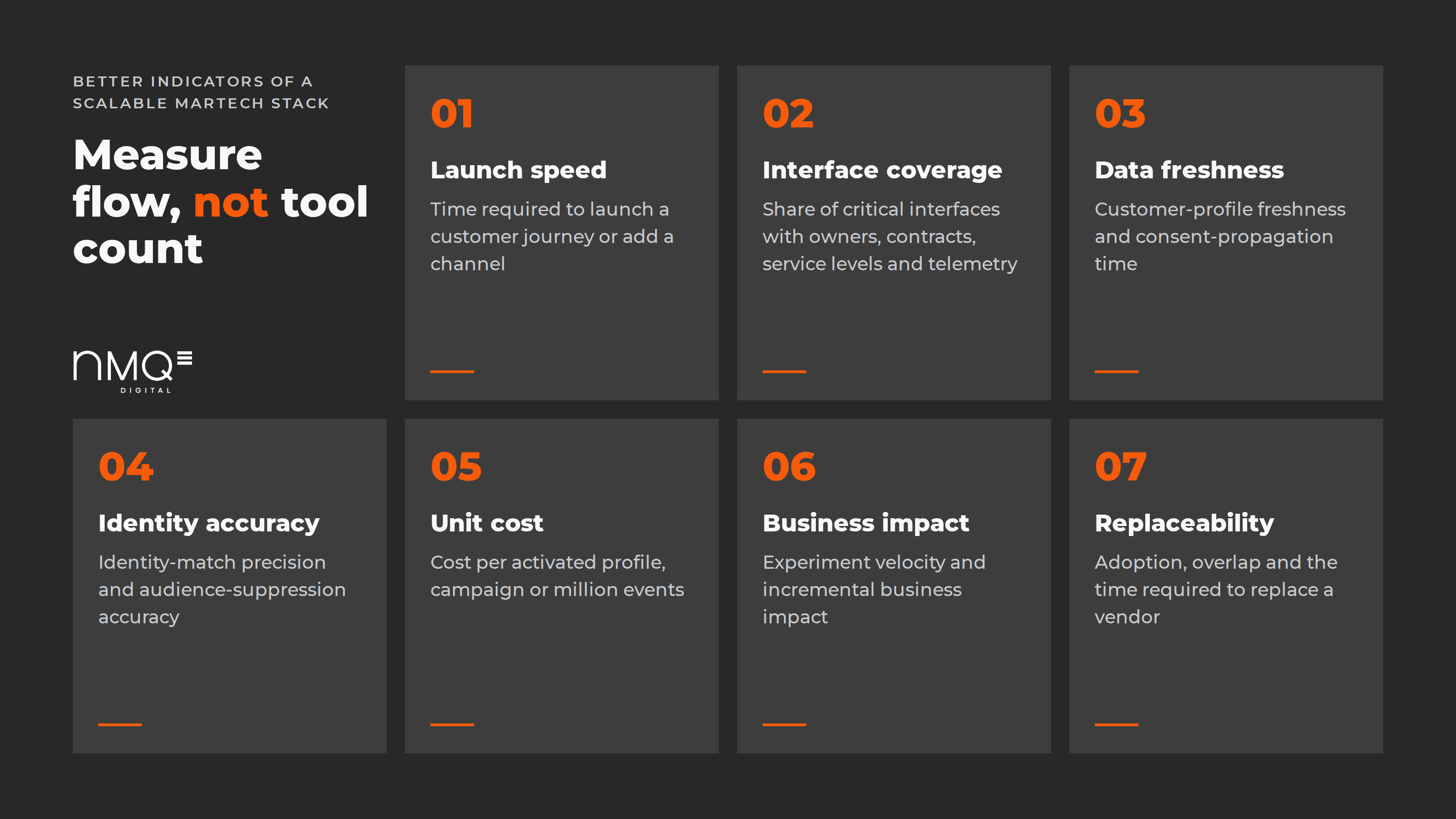
These measures show whether architecture is improving the organization's ability to change.
Build for the next change
No enterprise can predict which platforms, channels, or AI models will matter five years from now, so a permanent stack is the wrong target.
A better goal is to create stable boundaries around capabilities, data, and ownership, so the ecosystem can evolve without repeatedly starting over.
At NMQ Digital, we believe strong MarTech architecture begins with what a brand already has: simplifying unnecessary complexity, strengthening integration, and introducing new technology only where it creates measurable value.
The most scalable MarTech stack is the one that makes the next change easier.
Ready to understand where your current stack is creating friction, or where it can deliver more value? Contact NMQ Digital to discuss your MarTech architecture.