Customer Data Platforms: Evaluating, Implementing, and Activating a CDP for Global Brands
A strategic and technical guide to CDP selection, data onboarding, and use-case activation.
Yigitalp Avus

1. What Is a CDP and Why It Matters?
A Customer Data Platform (CDP) is software that collects customer data from every touchpoint such as web, app, email, CRM, POS, and offline sources and unifies it into a single, persistent customer profile that other marketing and analytics tools can use directly.
For a global brand, the challenge isn't collecting data. It's collecting data across dozens of markets, brands, languages, and legal frameworks (GDPR, CCPA, LGPD, and more), and still ending up with one trustworthy view of each customer.
Key takeaways
- A CDP unifies fragmented customer data into one persistent profile - the hard part for global brands is doing that across markets, languages, and legal frameworks.
- Two architectures exist: packaged (Adobe, Salesforce) and composable/warehouse-native (Snowflake + Hightouch) - fit depends on your data team's maturity.
- A CDP is an organizational commitment, not a set-and-forget tool - it needs dedicated headcount and cross-functional buy-in to pay off.
- Enterprise brands see measurable ROI: 15–30% reduction in ad spend waste, with payback typically under 6–12 months.
Why global brands invest in a CDP
- Unified profiles - A single customer, seen once. Instead of a fragmented profile spread across regional CRMs, e-commerce platforms, and loyalty systems.
- Privacy-safe targeting - Campaigns can activate on first-party data instead of third-party cookies, which matters more every year as third-party tracking keeps shrinking.
- One source of truth - Marketing, e-commerce, and customer service teams work from the same data instead of arguing about whose numbers are right.
- Faster market expansion - New markets or brands can be onboarded onto existing data infrastructure instead of rebuilding from scratch.
2. Evaluating a CDP
Not every CDP is built the same way. Before comparing vendors, it helps to know which of the two broad architectures you actually need.
Two architecture types
- Marketing CDP - A packaged CDP with data collection, identity resolution, segmentation, and campaign activation bundled together (e.g. Adobe Real-Time CDP, Salesforce Data Cloud). Faster to launch, less engineering effort.
- Composable / warehouse-native CDP - A CDP layer built on top of your existing cloud data warehouse (e.g. Snowflake, BigQuery) using reverse-ETL tools like Hightouch or Census. More flexible and often cheaper at scale, but needs a stronger internal data team.
A 5-step evaluation framework
To navigate the crowded vendor landscape, global enterprise teams should use this structured 5-step framework:
- Define & Prioritize Use Cases: Do not buy a CDP based on generic feature lists. Document your top 3–5 high-value business cases (e.g., 'Cross-channel churn prevention' or 'Real-time cart abandonment personalization'). If a vendor cannot definitively prove how they execute your specific scenarios, they are disqualified.
- Assess Architecture Fit (Packaged vs. Composable): Audit your current tech stack. If your company has already heavily invested in a central data warehouse (like Snowflake or BigQuery) and has a mature data engineering team, a composable architecture will save money and reduce data duplication. If your marketing team needs autonomy and lacks heavy engineering support, a packaged CDP is the right play.
- Test Identity Resolution in a Sandbox: Global brands suffer from fragmented customer data (e.g., matching a loyalty ID in Germany with an e-commerce email in France). Request a Proof of Concept (PoC) where the vendor runs their deterministic and probabilistic matching algorithms against your messiest real-world data sample - not a clean, sanitized demo environment.
- Model Total Cost of Ownership (TCO): Look beyond the software license sticker price. Build a 3-year TCO model that accounts for MTUs (Monthly Tracked Users), data ingestion/storage volumes, implementation partner (SI) fees, and the internal headcount required to run the platform.
- Pilot & Validate ROI in a Closed Market: Choose a single, digitally mature but smaller market (e.g., the Netherlands or Canada) to run a 60-day pilot. Prove that the CDP can successfully ingest data, build a segment, activate it, and generate a measurable revenue lift before signing off on a global rollout.
Vendor comparison snapshot
| Vendor |
Best fit for |
Core Strengths |
Critical Considerations / Blind Spots |
| Adobe Real-Time CDP |
Brands already on Adobe Experience Cloud |
Fast real-time processing (<1 min)
Deep, native ties to Adobe Journey Optimizer
Enterprise-grade B2B/B2C modeling built in |
High licensing fees
High complexity; often requires specialized agency partners to manage effectively |
| Salesforce Data Cloud |
Brands built around Salesforce CRM |
Built for unifying sales, service, and marketing interactions
Strong automated workflows within ecosystem |
Can feel like a 'walled garden'
Costs scale up quickly as data volume and processing consumption increase |
| Twilio Segment |
Teams wanting fast, developer-friendly setup |
Industry-standard data collection APIs
Strong developer documentation
Thousands of turnkey integrations |
Historically weaker native UI for non-technical marketers
Costs scale aggressively based on MTUs |
| Composable (e.g., Hightouch + Snowflake) |
Brands with strong internal data engineering |
Zero data duplication (stays in warehouse)
Total flexibility over data modeling
Drastically cheaper software licensing at scale |
No native UI for activation; requires data teams to build foundational pipelines
Not optimized out-of-the-box for real-time edge use cases |
3. The Pros, Cons, and Hidden Challenges of a CDP
Investing in a CDP is a major corporate milestone, but leadership must balance the operational realities before diving in.
The Upside (Why it pays off)
- Unlocking First-Party Data Value: Directly mitigates the loss of third-party cookies by turning anonymous web traffic into known, high-value lookalike cohorts.
- Operational Efficiencies: Eliminates the need for marketing teams to constantly submit IT tickets just to pull static email lists, democratizing data access.
- True Omni-channel Orchestration: Stops awkward customer experiences, such as serving a digital ad for a product the customer purchased in a physical store 2 hours prior.
The Downside & Hidden Challenges (What vendors won't tell you)
- The 'Data Garbage' Multiplier: If your regional CRMs are filled with duplicate entries and unverified emails, a CDP will simply match and amplify that bad data at scale.
- The Headcount Deficit: A CDP is not an automated 'set-and-forget' tool. It requires dedicated headcount, specifically a Technical Product Owner and a Data Analyst to continually monitor identity rules, data quality, and compliance.
- Political and Regional Silos: Global markets often protect their local customer databases fiercely. Overcoming internal corporate politics to centralize data governance can take longer than the technical integration itself.
4. Implementing: Data Onboarding
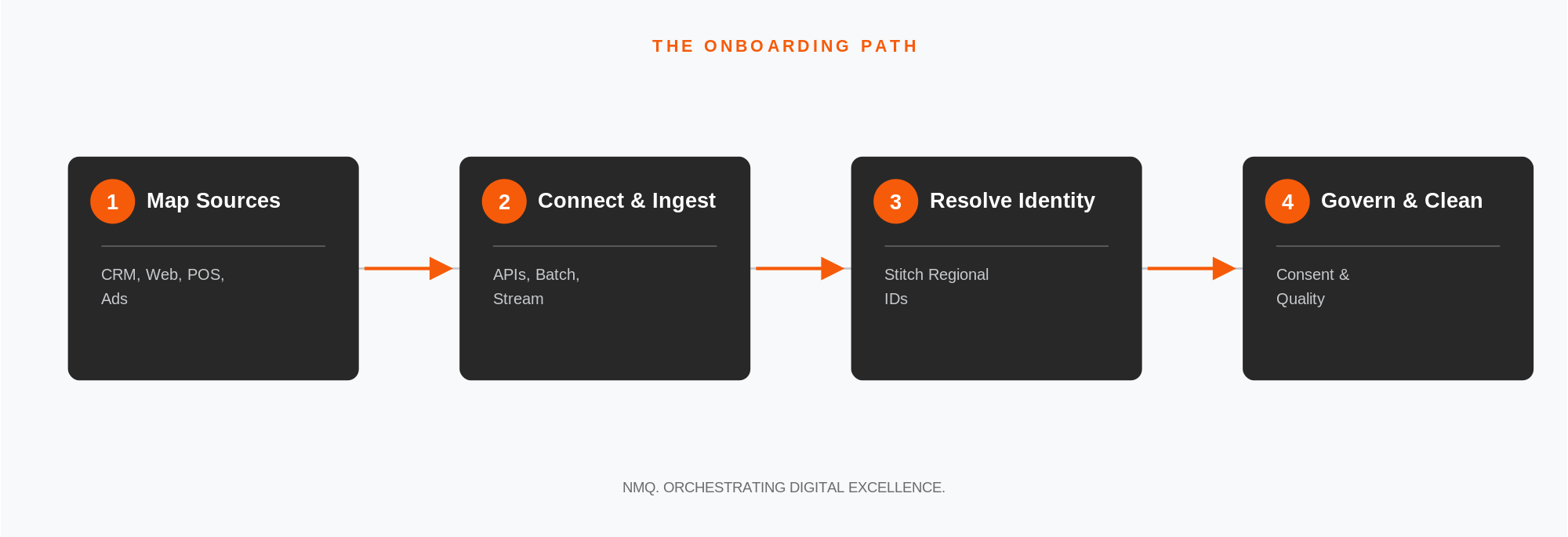
Implementation is where most CDP projects succeed or stall. For a global brand, this stage typically spans 4 to 6 months once you include 20+ data sources and custom identity resolution across markets.
The Onboarding Path
Common pitfalls to plan around
- Inconsistent IDs — Different markets often use different customer ID schemes —> plan identity resolution rules before connecting sources, not after.
- Consent management — GDPR, CCPA, and local equivalents don't always agree —> consent status needs to travel with the data, not live in a separate system.
- Garbage in, garbage out — A CDP amplifies whatever data quality already exists —> cleaning source systems first saves rework later.
- Phased rollout — Global rollouts succeed more often when one market goes live first, proves the model, and then others follow.
5. Activating Use Cases
A CDP only pays for itself once profiles are actively used — for personalization, segmentation, or real-time decisioning.
| Use case |
What it does |
Typical owner |
| Unified segmentation |
Build audiences across every channel from one profile |
Marketing |
| Personalized on-site experience |
Tailor content or offers per visitor in real time |
E-commerce / CRO |
| Suppression & frequency capping |
Avoid over-messaging the same customer across channels |
CRM / lifecycle |
| Churn & LTV modeling |
Feed unified data into predictive models |
Analytics / data science |
| Cross-market reporting |
Compare customer behavior across regions consistently |
Global marketing ops |
6. Global Brand Case Studies & Measurable Business Impact
To justify the investment to executive leadership, it helps to examine how major global enterprises across food & beverage, media, retail, and B2B sectors leverage CDPs to drive measurable business impact.
| Global Brand |
CDP Architecture Used |
Core Challenge |
Measurable Business Impact / KPIs |
| Domino's Pizza |
Twilio Segment |
Fragmented digital ordering data across mobile apps, web, and local franchise stores. |
65% reduction in CPA on paid channels
23% lift in incremental conversions for new acquisition
16% increase in retention campaign conversion |
| FOX Sports |
Twilio Segment |
Connecting real-time streaming habits and mobile interactions for millions of fans. |
376% increase in mobile app visitors engaging with personalized 'For You' content
>$1.2M saved annually in customer data QA labor |
| AB InBev |
Twilio Segment / Enterprise Composable |
Managing a global footprint across 200+ brands and hundreds of thousands of B2B retail outlets. |
Built unified B2B platform processing 3B+ data points monthly
Scaled to drive 1.3M+ active app orders weekly |
| Fender Guitars |
Twilio Segment |
Turning one-time guitar buyers into recurring subscribers for their digital learning app. |
29% drop in customer churn for Fender Play
5% increase in active paying users, driving recurring ARR |
| Siemens Healthineers |
Adobe Real-Time CDP |
Complex B2B buyer journeys with strict medical compliance and multi-touch sales cycles. |
2x (100%) increase in email engagement & open rates
Streamlined regional consent and account journeys |
| Dick's Sporting Goods |
Adobe Real-Time CDP |
Unifying online browsing with in-store POS transactions across hundreds of retail stores. |
Real-time omni-channel personalizations
Immediate suppression of paid ads for items bought in-store earlier that day, boosting ROAS |
Enterprise Benchmark Summary
Across Forrester and McKinsey industry studies on enterprise CDP implementations:
- Paid Media Efficiency (ROAS): 15% to 30% reduction in ad spend waste through real-time customer suppression and lookalike modeling.
- Operational Savings: $150,000–$300,000 saved annually per data engineering team by eliminating manual point-to-point API pipelines.
- Typical Payback Period: Under 6 to 12 months for mature enterprise brands with dedicated business owners.
7. Quick-Reference Checklist & Strategic Solutions
Have you defined the top 3 use cases the CDP needs to solve in year one?
- The Challenge: Teams get distracted by shiny features and try to implement 50 use cases at once, leading to analysis paralysis.
- How to Address: Enforce a strict 'Use-Case Gatekeeping' process. Choose exactly one acquisition use case (e.g., paid media suppression), one retention use case (e.g., cart abandonment), and one operational use case (e.g., cross-channel reporting). Ban all other requests until these three are fully live and measured.
Does the architecture (packaged vs. composable) match your team's technical capacity?
- The Challenge: Buying a composable CDP without dedicated data engineers, or buying a packaged CDP when your data warehouse is your core strategic infrastructure.
- How to Address: Conduct a simple talent audit. If you do not have dedicated SQL/analytics engineers assigned to marketing operations for at least 20 hours a week, do not buy a composable CDP. Lean toward a packaged solution, or secure explicit budget for specialized hires before signing the contract.
Has identity resolution been tested against your messiest real data?
- The Challenge: Deterministic matching fails because global phone number formats, accents, or regional naming conventions vary wildly.
- How to Address: Run a 'Stress-Test Hackathon' during the evaluation phase. Provide the vendor with a raw data dump containing common regional errors (e.g., missing country codes, overlapping emails for shared family accounts) and require them to visually demonstrate how their platform accurately stitches or separates those profiles.
Is consent and privacy handling built into the data model from day one?
- The Challenge: Ingesting data from a market like Germany without verifiable opt-in flags, resulting in regulatory compliance failures and fines.
- How to Address: Implement a 'No Consent, No Ingestion' schema rule. Your CDP data model should feature mandatory global compliance attributes attached to every single profile event (e.g., consent_GDPR = True, consent_marketing_email = False). If an incoming payload lacks these fields, the CDP should automatically quarantine the record.
Is there a named business owner for activation, not just a technical owner?
- The Challenge: IT successfully builds the platform, but the marketing team doesn't know how to use it, leaving the software sitting on the shelf.
- How to Address: Appoint a 'CDP Product Manager' who sits squarely between IT and marketing. This individual translates business campaign requirements into data needs and holds marketing KPIs (such as incremental revenue lift or media spend reduction) to ensure the platform actively drives value.
Is the first rollout scoped to one market or brand before going global?
- The Challenge: Attempting a simultaneous global launch across 15+ countries, which inevitably collapses under the weight of localized legal, language, and technical blockers.
- How to Address: Use a 'Lighthouse Market' strategy. Select a single market that represents a microcosm of your business. Document every roadblock, create a repeatable 'onboarding playbook,' and use that success to build momentum and train regional teams during the subsequent global expansion phases.
8. Conclusion
A Customer Data Platform is no longer a luxury asset for global brands; it is a foundational prerequisite for navigating a first-party, privacy-centric digital economy. However, enterprise CDP success is rarely just a software deployment challenge. More often, it is an organizational transformation hurdle that requires breaking down data silos, navigating localized data governance, and enforcing cross-functional accountability between marketing and data engineering.
By anchoring your procurement process in tightly defined, high-value use cases, aggressively stress-testing vendor matching algorithms in sandboxes, and committing to a structured checklist with robust strategic solutions, your brand can bypass the common pitfalls of enterprise software stagnation. Ultimately, a successful CDP setup turns fragmented global databases into a clear, unified competitive advantage, allowing your marketing engines to deliver real-time, personalized customer experiences at scale across every market.
A CDP is only as strong as the orchestration behind it. The platform stitches the data together, but someone still has to make strategy and execution work as one system.
Talk to NMQ about your CDP roadmap →
References