
Segmentation, Content and Data: How Personalization Works at Scale
Dynamic content personalization is an approach where sections of a single email template change for each recipient, based on data such as their segment, behavior and location.
Every interaction a customer has with a brand generates data. That data reveals their interests, engagement patterns, and where they are in their relationship with the brand. All of this can shape the next message they receive. Global brands operating across markets also have to account for differences in language, timing, and local expectations.
Privacy regulations are strict, and they differ from one market to the next, from GDPR in the EU to the CCPA in California. Customers are also more aware of their rights: in Cisco's 2024 Consumer Privacy Survey, 53% of consumers said they were aware of their country's privacy laws, up from 36% in 2019. These make it important to only utilize the data customers have agreed to share.
Done well, personalization is what turns email from a broadcast channel into one that resonates with each recipient.
This article explores how personalization can go beyond a first name through segmentation, dynamic content modules, and the CRM data models that connect them. It provides guidance for marketing teams managing global email campaigns, where personalization is crucial to driving relevance at scale.
Why Personalization Needs to Go Beyond First Name
Including a recipient’s first name in the subject line or in the message has long been seen as a standard way to personalize emails and lift engagement. An experiment by Sahni, Wheeler and Chintagunta in 2018 found that including the first name in the subject line increased the probability of a recipient opening the email by 20%, from 9.05% to 10.80%. However, when Defau and Zauner (2023) set out to reproduce the experiment years later, they found no positive effect on open or click rates, suggesting that recipients may have grown used to the tactic as it became common practice.
Another study done by Nobile and Cantoni in 2023 showed that while a small positive difference was seen, it was not statistically significant. In their test, the personalized group had an open rate of 53.6% against 49.4% for the control group, and a click-through rate of 9.1% against 8.8%. A name alone no longer gives recipients a reason to engage.
Segmentation That Shapes the Message
Relevance starts with knowing which group a customer belongs to based on their demographics, location, behavior, and lifecycle stage. Demographics and location set the baseline, while behavioral data, prior engagement and lifecycle stage reveal how a customer interacts with the brand. A single email might reach someone who subscribed last week, someone who opens every email and someone who hasn’t engaged in months. Each is likely to respond to something different. Used together, these signals decide which version of each message a customer receives, in every market.
Dynamic Content Modules as the Building Blocks
Content modules are the individual sections that make up an email. Dynamic content modules take a data-driven approach, where the content of each section changes based on who receives the email and which segment they belong to. This allows global marketing teams to maintain one template per email, instead of a separate build for every segment and market.
The example below shows one email template with a single dynamic module. A new subscriber, a regular opener and a lapsed customer each see a different version of the same section, while the rest of the email stays the same. A fallback version covers recipients whose data is missing.
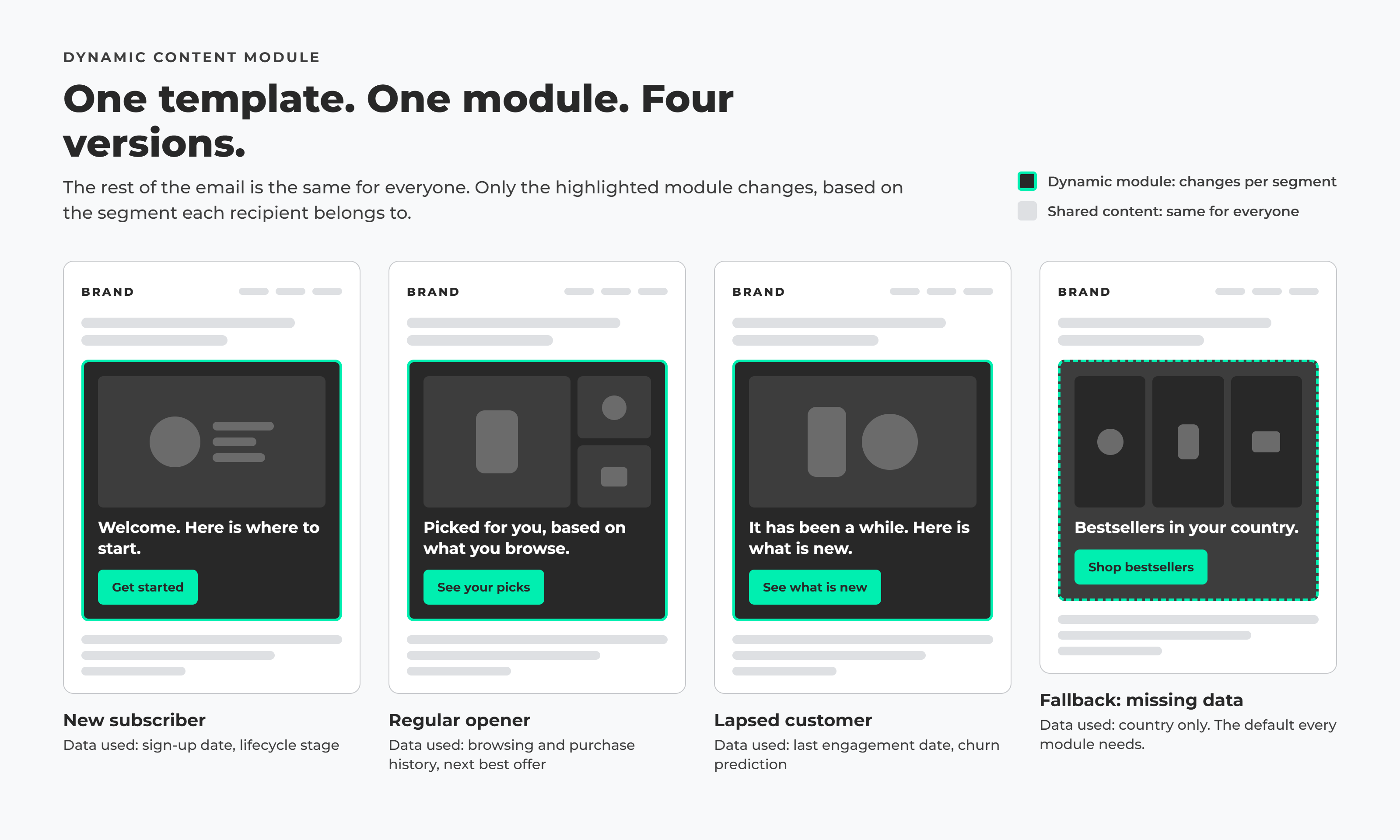
One email template with a single dynamic module: each segment sees its own version, and a fallback covers recipients with missing data.
In practice, a retailer might change the hero image based on the product category a recipient shops most, or populate the key image, background color and product name with the item each recipient has added to their wishlist.
CRM Data Models Behind It All
Segments and dynamic content modules heavily rely on the data behind them. A CRM data model can bring together many types of customer data. Some commonly used examples are survey responses, stated preferences, behavioral data such as opens, site visits, purchases, and profile attributes such as country, language and demographics. Predictive data builds on these: a next best offer model, for example, uses a customer’s profile data along with their behavioral and transactional history to recommend products or offers they are most likely to respond to. This prediction model can then be used to populate a product module in an email. Similarly, a churn prediction model can estimate how likely each customer is to disengage, allowing marketers to adapt the content accordingly.
Together, the data model feeds the segments, the segments determine which version of each module a customer sees, and one template can serve every market with content adapted to each recipient.
Key Focus Points for Global Email Teams
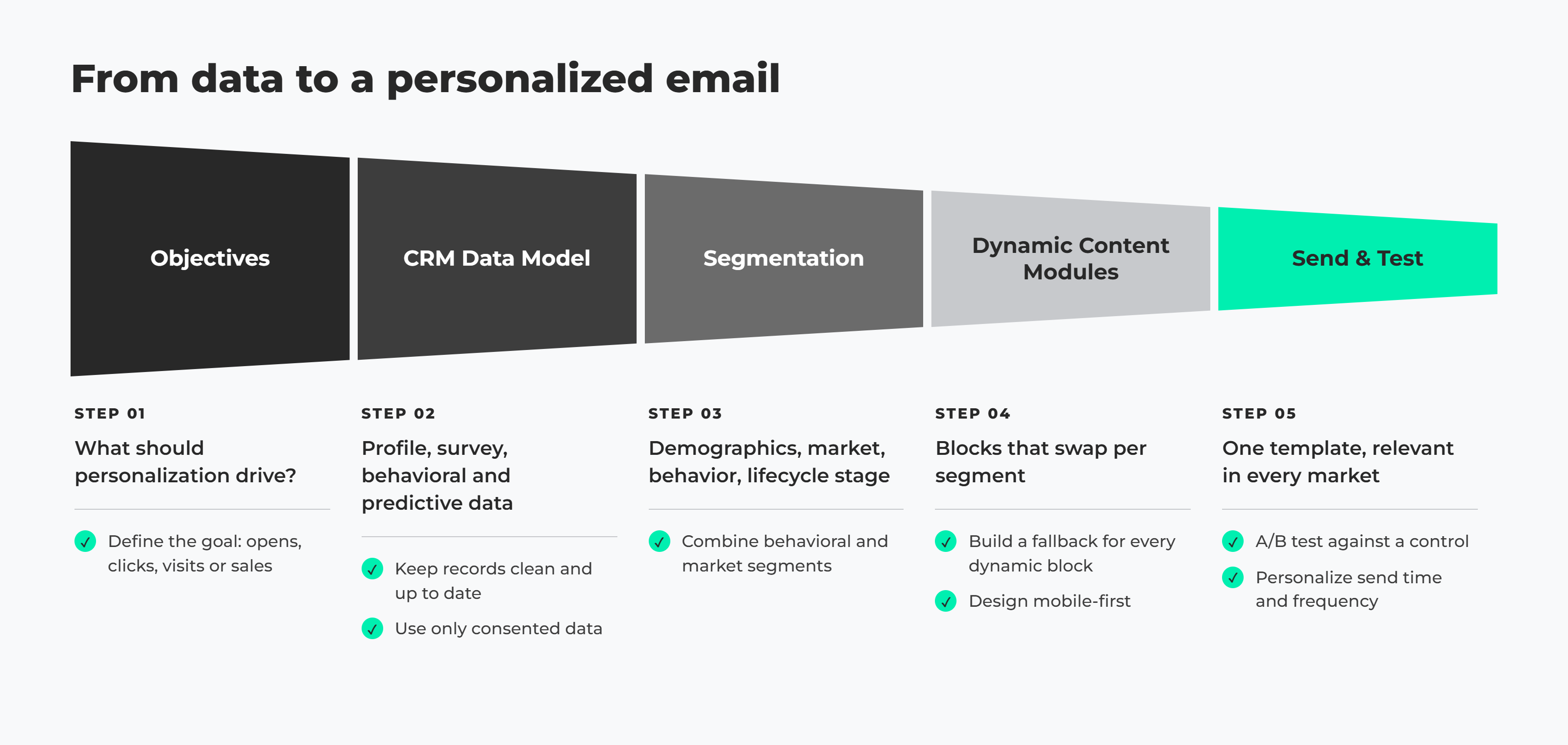
1. Establish your objectives clearly.
Deciding what a campaign needs to drive, whether that’s opens, clicks, web visits, or conversions, shapes where personalization matters the most. In our experience, subject lines and send time carry more weight for opens, while product and offer modules do more for conversions. Clear objectives help define the overall personalization strategy and give every test a clear measure of success.
2. Maintain data hygiene and pay attention to consent.
Successful personalization depends on how accurate the data behind it is, therefore auditing your database routinely is important. This means keeping records complete, consistent, and up to date, from contact details to the attributes and preferences that feed your segments and content modules. Consent matters just as much: opt-in should be clear, preferences easy to update, and data use in line with privacy regulations in each market.
Explore NMQ's data and analytics services.
3. Build fallbacks for your dynamic content blocks.
Some customers may have missing or incomplete data, so each module needs a default version. A product recommendation block, for example, can default to a bestselling product in the recipient’s market when no browsing history or predictive attribute is available. Test every variation before sending, including how each one renders on mobile and across markets and languages.
4. A/B test against a control group.
Comparing a personalized version with a non-personalized one helps measure the performance boost the personalization brings to your campaigns. Test one variable at a time so the result can be traced back to a specific change. Make sure each test group is large enough for the difference to be meaningful. Results can also vary between markets, so a winning variation in one country is worth validating in others before rolling it out.
5. Personalize send time and frequency.
Utilize engagement data to see when individual customers tend to open and how often they respond before interest drops. Adjusting timing and cadence per customer keeps relevance high without adding more sends. Customers who engage less often may respond better to fewer, more targeted emails than to the full campaign calendar.
Frequently Asked Questions
Does first-name personalization still work in email marketing?
On its own, the evidence suggests it no longer makes a measurable difference. Defau and Zauner (2023) found no positive effect on open or click rates, and Nobile and Cantoni (2023) found only a small difference that was not statistically significant.
What is a dynamic content module?
A dynamic content module is a section of an email template whose content changes based on who receives the email and which segment they belong to, so one template can serve many segments and markets.
What happens when a recipient's data is missing?
Each dynamic module needs a fallback version. A product recommendation block, for example, can default to a bestselling product in the recipient's market when no browsing history or predictive attribute is available.
How do you measure whether personalization is working?
Compare a personalized version against a non-personalized control group, test one variable at a time, and make sure each group is large enough for the difference to be meaningful.