
Resource Allocation Across Multiple Markets
A practical toolkit for marketing ops leaders balancing capacity, priorities, and timelines across 10+ country markets.
»READ MORE
Balancing capacity, priorities and timelines when your team spans 10+ countries.

Ask a marketing operations leader running a team across ten or more countries what breaks first, and the answer is rarely strategy or planning. It is capacity. The calendar is agreed, the budget is signed off, the priorities are documented - and then a designer in one market is double-booked, a translation queue backs up in another, and a launch date quietly slips because nobody had visibility into who was actually available to do the work.
This is a marketing resource planning problem, not a talent problem, and it is a widespread one: Content Marketing Institute's 2025 B2B benchmarking research found that 54% of B2B marketers cite lack of resources as a top challenge. Spread that same dynamic across ten or more markets, time zones and local stakeholders, and it compounds fast.
This article looks at multi-market resource allocation through a project management lens - a short, practical guide for marketing operations leaders and the project managers who keep their programs on track.
Most teams know what work is planned. Far fewer know who actually has time to do it. Without a shared view of who's working on what across markets, managers end up guessing - assigning work based on gut feel, or simply giving it to whoever answers first. The result: the same few people get pulled into every priority project, while others with free capacity never get asked.
Each country market runs its own campaign calendar, often in its own systems, planned by its own team. Nobody has a single view across all of them. When two markets independently schedule their biggest push in the same week and both need the same specialist, neither one planned around the other - because neither one could see the other's calendar in the first place. This isn't a scheduling mistake. It's what happens when ten markets each plan in isolation, without a shared view of who else is drawing on the same pool of people.
Coordination overhead rises the moment teams stop sharing a working day. A 2024 study published in Organization Science (Chauvin, Choudhury & Fang) found that each additional hour of time difference reduces real-time, synchronous communication between colleagues by around 11%, compared with fully co-located teams. Across a 10+ country footprint, that effect compounds quickly: a one-day review cycle in a single-market team can easily stretch to three or four days once a request has to travel through several time zones to get a response.
If any of this sounds familiar, you're not alone - and it's fixable. Talk to NMQ's project management team about mapping a resourcing model for your markets, or read on for a simple toolkit you can start using this week.
None of this needs complex tooling. It needs the same discipline a PM would bring to any complex program: visibility, consistent prioritization, and a regular rhythm for surfacing conflicts before they become missed deadlines.
Capacity needs to be visible in one place - by market, by role, by week - not reconstructed from memory before every steering meeting. A shared tracker or PPM tool that shows planned demand against available hours, refreshed on a fixed cadence, is the single highest-leverage habit here. Most “priority conflicts” are really visibility gaps that only look like priority disputes once a deadline is missed.
“Global priority” and “local priority” need to be measured against the same criteria, or every market will keep ranking its own work first. A simple scoring model - covering business impact, deadline risk and effort required - lets a project manager compare a global campaign against a local compliance update on equal terms, rather than on who escalated loudest.
Ad hoc escalation does not scale past a handful of markets. A brief, recurring cross-market meeting - weekly or biweekly, with a fixed agenda of new demand and at-risk timelines - gives every market lead a predictable moment to flag pressure early. Its value comes from being scheduled and routine, not from being reactive.
Identify which markets share real working hours and route time-sensitive approvals through those windows. For markets with little or no overlap, add an extra review cycle to the timeline up front, rather than discovering the delay mid-project. A realistic schedule beats an optimistic one every time.
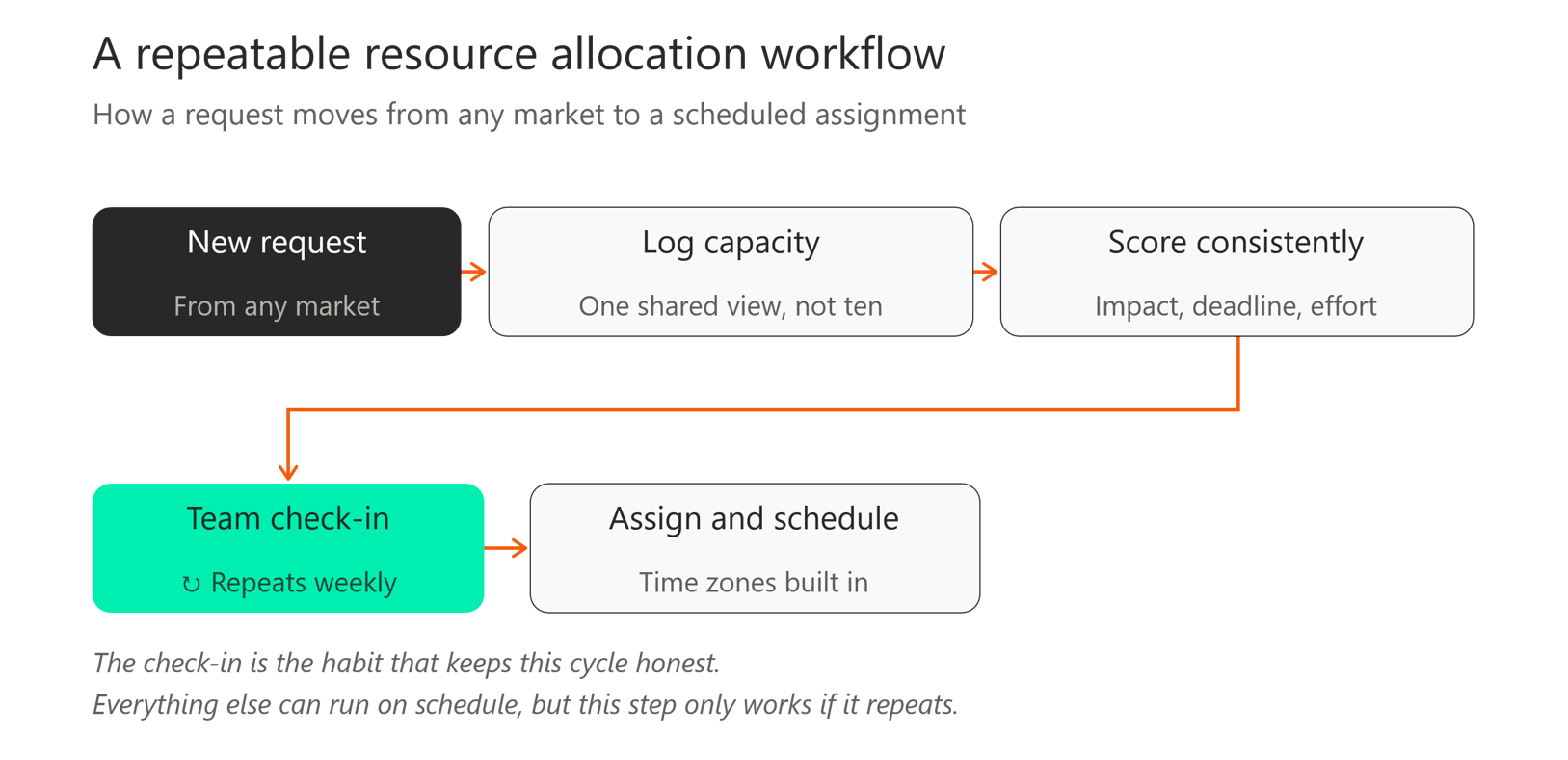
If your organization is still resourcing multi-market campaigns from memory and goodwill, the four habits above are the starting point: one capacity view, one scoring model, one recurring check-in, and time zones planned into the schedule. If you are further along and running into specific execution challenges - PPM tooling or cross-market governance design - those are solvable with the right operational support.
Learn more about NMQ's Project Management approach.
Our team works across markets, disciplines and time zones to keep complex digital programs on track. If you're building out a resourcing model for a multi-country marketing operation, get in touch →
References
Our Blog