
Speed without governance is noise, and governance without speed is a bottleneck. Most enterprise content teams feel stuck between the two, yet the delays rarely come from governance itself. They come from governance that was never designed, with rules living in people’s heads, approvals running on email and every market working slightly differently.
What Is a Content Governance Framework?
A content governance framework is the set of roles, standards, workflows and lifecycle rules that controls how an organization’s content is created, reviewed, published, maintained and retired. A content governance framework answers four questions for every page and asset: who owns it, who approves changes to it, which standards it must meet, and when it should be updated or removed.
Content strategy and content governance are different jobs. Content strategy decides what to publish and why. Content governance decides how publishing happens consistently, at scale and across markets.
How a Content Governance Framework Works
An enterprise content governance framework rests on five pillars. Each pillar protects content quality and removes a source of delay at the same time.
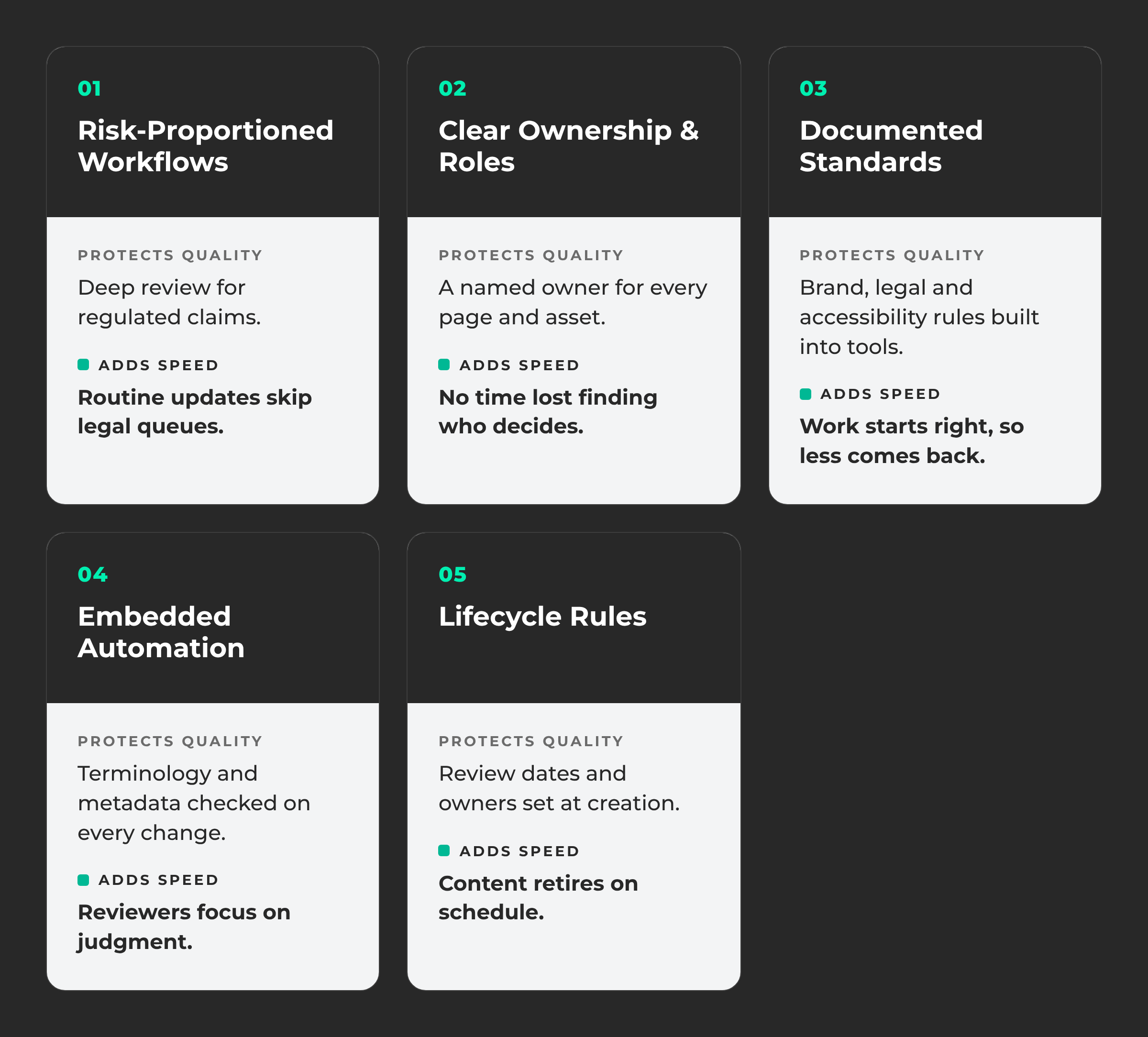
Figure 1. The five pillars of an enterprise content governance framework, and what each one does for quality and speed.
1. Risk-Proportioned Workflows
Risk-proportioned workflows match review effort to the risk of each change. A legal disclaimer and a typo fix should not travel through the same approval chain. A practical model uses three tiers:
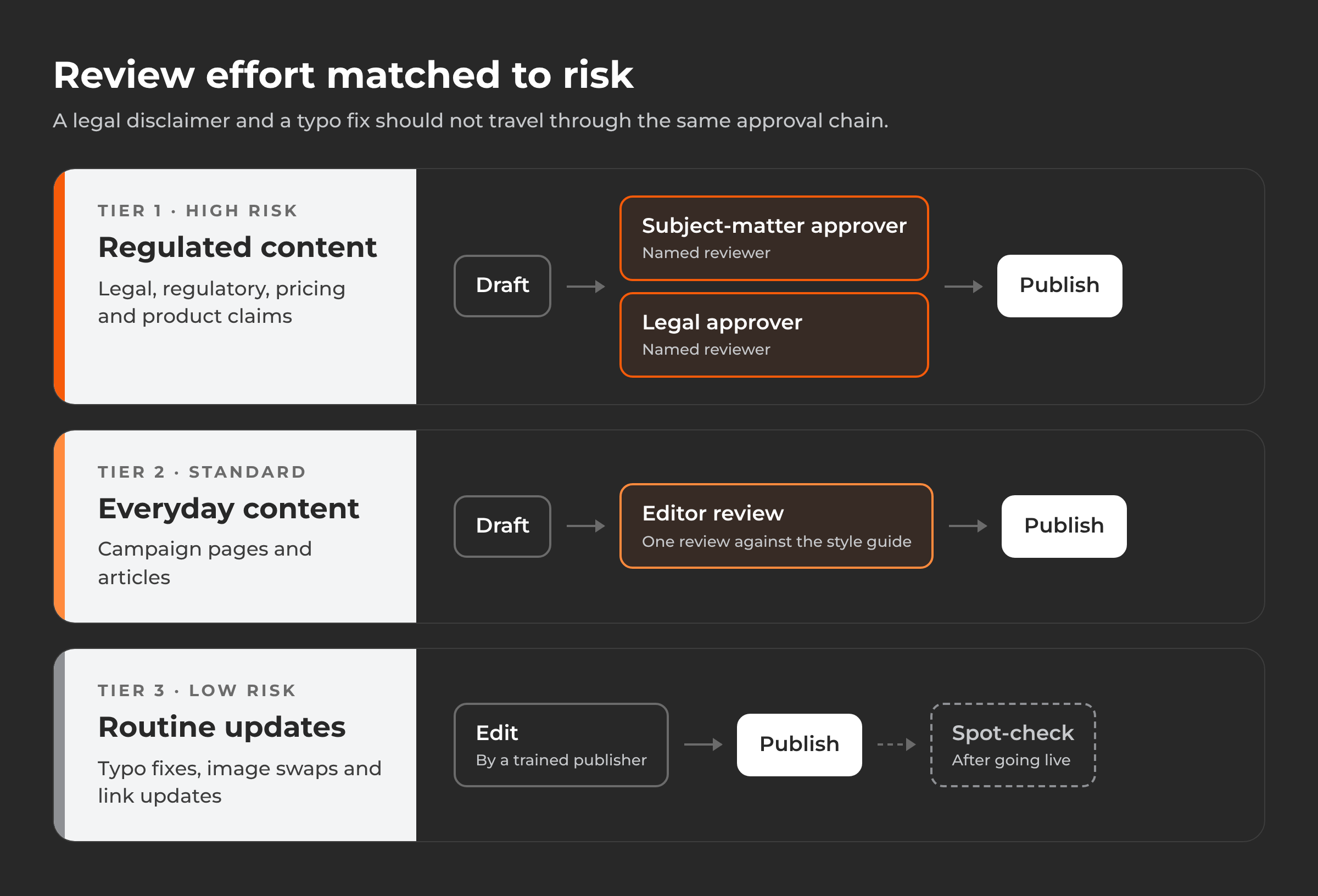
Figure 2. Risk-proportioned review: high-risk content goes to named subject-matter and legal approvers, standard content gets one editor review, and low-risk updates are published directly and spot-checked afterwards.
2. Clear Ownership and Roles
Every page and asset needs one named owner, because ownership by team is ownership by nobody. In multi-market organizations, the most workable model is federated. A central team owns brand, legal language, accessibility and the core style guide, while each market owns local adaptation within those standards. We set out the same federated model for marketing technology in our guide to building scalable MarTech stacks.
3. Documented Standards and Policies
Standards only work when they are written down and enforced inside the tools people use. That covers brand voice, legal language and accessibility, plus asset rules such as mandatory metadata, naming conventions, file size limits and one approved version of every file.
4. Embedded Automation and Tooling
Automation turns written standards into checks that run on every change. Templates can carry required fields such as disclaimers and alt text, and automated pre-publish QA can catch broken links, accessibility errors and banned terms before a reviewer looks. Reviewers then spend their time on accuracy, tone and user needs, which machines cannot judge. Anything a machine can check, a machine should check.
AI tools fit the same model. In our view, AI belongs in a governed content workflow only with scoped permissions, audit logs and a human approval step before anything goes live.
5. Lifecycle Rules
Lifecycle rules decide what happens to content after it is published. Every page and asset should get a review date, an expiry or retention rule and a post-publish owner on the day it is created. For time-bound or regulated content, a mandatory expiry date can alert the owner and unpublish the page automatically. Lifecycle decisions made upfront are the ones that actually happen.
Why Content Governance Matters
Poor content governance shows up as wasted assets and missed deadlines. In a November 2025 survey of 500 marketing professionals by Frontify and Statista, 18% of marketing assets were never used, mostly because they were too hard to find, and 28% of projects were delayed when assets could not be found. Canto’s State of Digital Content 2025 report, based on 423 marketing and creative professionals, found that 45% were losing productivity to disorganized workflows, up from 38% in 2024.
For content and marketing leaders, the stakes go beyond efficiency:
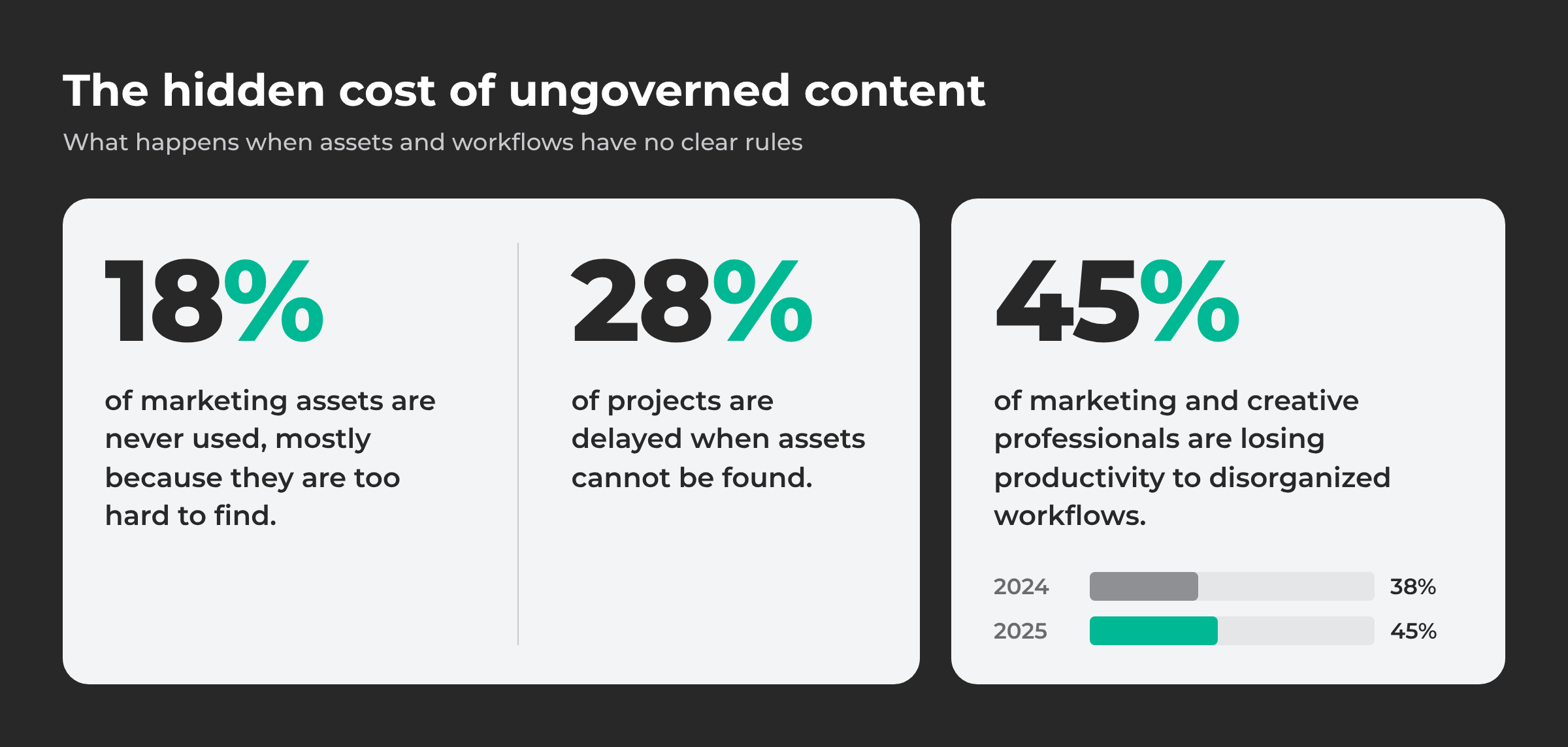
Figure 3. Stats on ungoverned content: 18% of assets never used, 28% of projects delayed, 45% of professionals losing productivity to disorganized workflows.
To check whether a framework is working, track process friction alongside content performance:
- First Time Right: the share of changes that go live correctly on the first attempt.
- Time in review, by tier: where work waits, and for whom.
- Rework rate: how often work comes back because the standard was unclear.
- Asset reuse rate: whether people can find and trust the library.
Content Governance Examples
Public examples show each pillar working at scale.
- GOV.UK (ownership and standards). Around 3,000 people across the UK government publish to GOV.UK, according to the Government Digital Service. In June 2026, GDS merged four separate manuals into a single content and publishing guidance site, rewriting more than 130 pages so every publisher works from one standard.
- FINRA Rule 2210 (risk-proportioned workflows). FINRA Rule 2210 requires a registered principal to approve a US broker-dealer’s retail communications before use, while correspondence and institutional communications are covered by supervision and review procedures instead of pre-approval.
- GitLab (automation). GitLab’s documentation team enforces its style guide with Vale, an open-source prose linter. According to GitLab’s documentation, only error-level rules, such as branding and trademark issues, fail the pipeline, while warnings and suggestions guide writers without blocking changes.
- Adobe Experience Manager Assets (lifecycle rules). Adobe’s documentation describes asset expiry dates tied to license terms, after which AEM flags the asset as expired and can be configured to notify the asset’s uploader, so nobody has to remember a license end date.
- NMQ’s own content operations (measurement). In our web content operations, every request goes through a pre-publish checklist matched to its tier, and we track First Time Right on every deployment. In our experience, it is the clearest single signal that quality and speed are working together.
Frequently Asked Questions
What is the difference between content strategy and content governance?
Content strategy decides what content an organization creates and why. Content governance defines the roles, standards, workflows and lifecycle rules that make sure that content is published consistently, accurately and on time.
Does content governance slow publishing down?
Poorly designed content governance slows publishing down, because it adds review queues at the end of the process. Well-designed content governance speeds publishing up by tiering review to risk, making ownership clear and automating routine checks.
How often should a content governance framework be reviewed?
We recommend reviewing operational metrics monthly, auditing content quarterly and reviewing the framework itself at least once a year, or whenever a new market, platform or regulation changes how content moves.