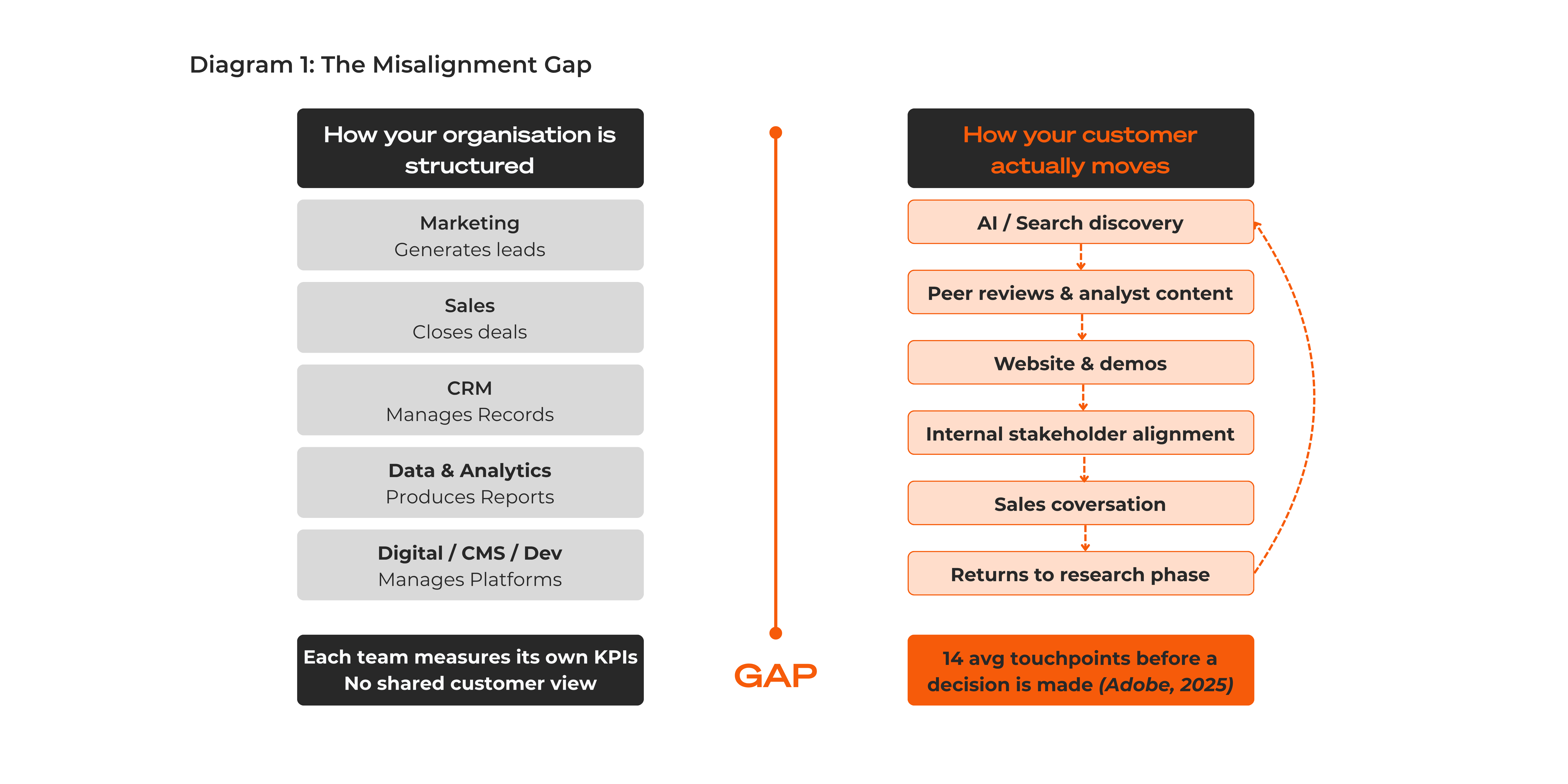
In most complex B2B organizations, the customer sits at the center of every strategy presentation and almost nowhere in the actual operating model. Marketing pursues leads. Sales closes deals. CRM manages records. Data produces reports. Each function executes competently within its own boundaries - and yet the customer's experience across all of them is fragmented, inconsistent and often invisible to the people responsible for fixing it.
This is not a resourcing problem. It is a structural one. And the cost of leaving it unresolved is rising.
B2B buyers now engage in around 14 meaningful touchpoints before a decision is made - moving through websites, reviews, analyst content, demos, internal conversations and live interactions. They expect all of these to feel like a single, connected experience, with context carrying across every channel. The organizations that cannot deliver that continuity, are losing ground to those that can. Customer-obsessed firms grow 2.5 times faster and retain 2.2 times more customers annually than those without a customer-centric approach.
Building a genuinely customer-centric digital strategy in a complex B2B organization is not a campaign initiative. It is a re-orientation of how the entire commercial operation thinks, plans and executes. This article sets out what that re-orientation requires - and what it looks like in practice.
Why B2B Complexity Works Against the Customer
The structural challenge is well-documented. B2B buying committees have grown to an average of 11.2 stakeholders in 2024, up from 6.8 in 2019. Forrester finds that 73% of enterprise purchases now extend beyond their original timeline because internal alignment breaks down before a decision gets made.
That complexity exists on both sides of the relationship. Internally, marketing, sales, CRM, data and digital teams frequently operate from different mandates, different metrics and different interpretations of what the customer actually needs. The result is a go-to-market motion that is siloed by design, even when customer-centricity is stated as a priority.
Gartner describes this as a "commercial convergence" problem: most commercial teams still formulate strategies and execute plans based on functional silos, producing operational inefficiencies, misaligned priorities and generic messaging. Solving it requires more than better communication between teams. It requires a shared operating model built around the customer's journey - not around internal departmental logic.
The Three Structural Failure Modes
Most customer-centric transformations stall at the same points. Understanding where they break down is the first step to avoiding it.
Failure 01: Treating Technology as the Strategy
Technology investment without strategic alignment is one of the most expensive mistakes in B2B digital transformation. Organizations invest in CRM platforms, marketing automation, CMS systems and data infrastructure; and then discover the tools are only as effective as the operating model they support. Only 41% of B2B organizations say they have a unified customer data foundation capable of supporting AI at scale. Without that foundation, even the most capable technology stack produces fragmented outputs.
Technology should follow strategy, not precede it. The question to answer first is: what does the customer need to experience at each stage of their journey, and what does our operation need to deliver consistently to make that happen? The technology investment follows from the answer.
Failure 02: Treating Stakeholder Alignment as a Kickoff Moment
According to Gartner, 80% of B2B deals fail not because of the external sales process, but because of internal consensus-building challenges. The same dynamic that stalls buying decisions also stalls digital strategy internally. When senior stakeholders across marketing, sales, IT and commercial leadership have not aligned on a shared customer strategy, every subsequent decision (on channels, tools, content and measurement) becomes contested territory.
Alignment is not a kickoff meeting. It is an ongoing governance structure that keeps customer outcomes at the center of every investment and execution decision.
Failure 03: Measuring Activity Instead of Outcomes
Only 26% of B2B marketers rate their strategies as "very effective." A significant driver of that dissatisfaction is measurement frameworks that track the wrong things. Impressions, open rates and session counts are activity metrics. They tell you what happened — not whether it moved the customer closer to a decision or deeper into a relationship.
Customer-centric measurement starts from the customer's experience and works backwards: are customers finding what they need at each stage? Are they returning? Are they converting, retaining and expanding? These outcomes require cross-functional data sharing — which is itself a structural challenge, and a reason why data governance must be part of the strategy from the start.
Four Imperatives for Getting It Right
 01. Align Around the Customer Journey, Not the Org Chart
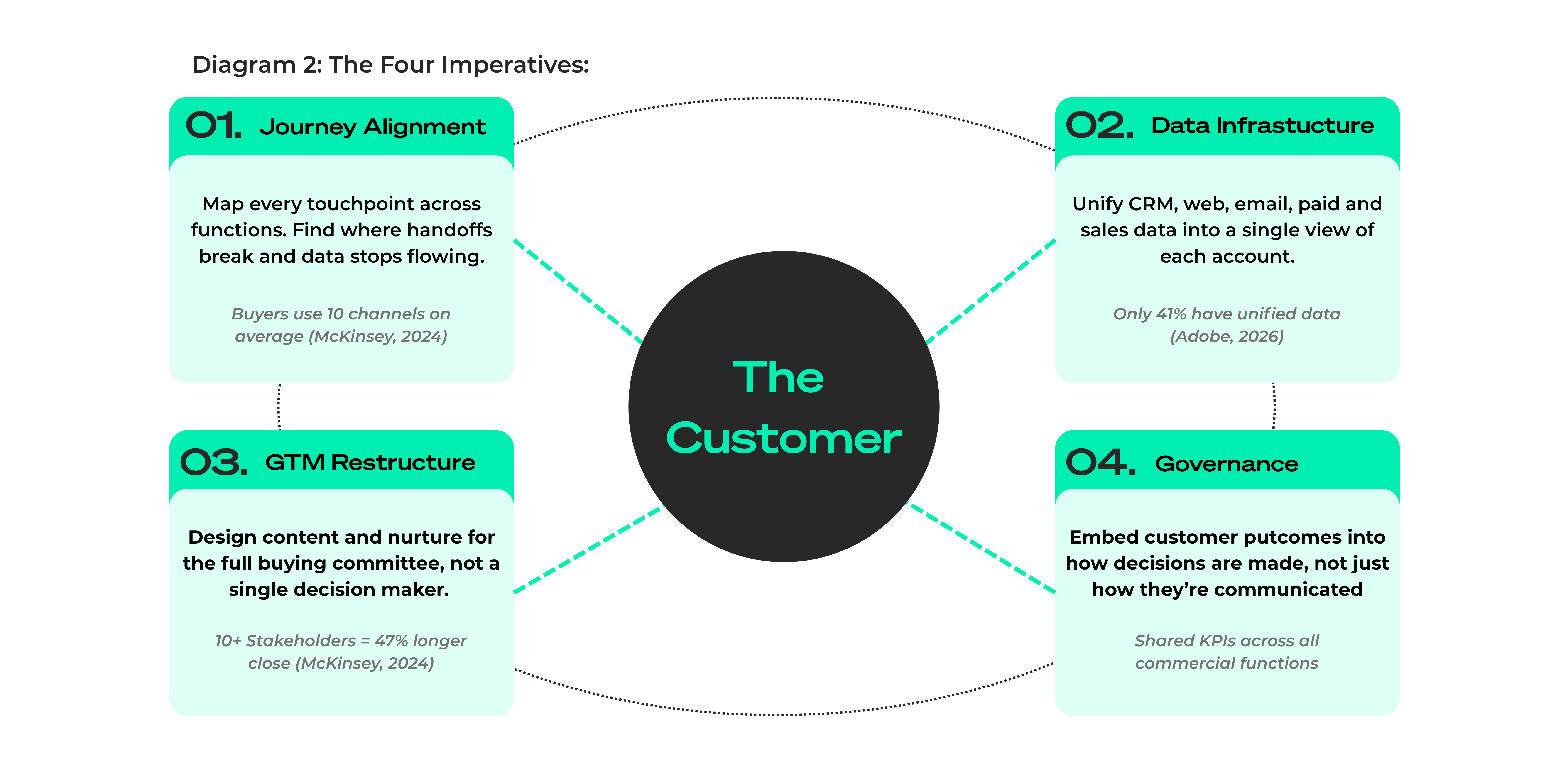
Map the full customer journey from first discovery through to post-purchase. Identify every point at which a different team owns a touchpoint. That exercise will reveal where handoffs break down, where data stops flowing and where the customer's experience becomes inconsistent.
B2B buyers now use an average of 10 different interaction channels on their journey - up from just 5 channels in 2016. They spend only 17% of their total buying time in contact with suppliers. The rest happens in digital channels your teams may not be tracking, or may be managing in isolation.
02. Build Shared Customer Data Infrastructure
Delivering more personalized customer experiences is the top AI investment goal for 59% of B2B organizations over the next 18 months. Personalization at scale requires a unified data layer; one that connects CRM, web behavior, email engagement, paid media signals and sales activity into a coherent picture of each account. This is a governance and architecture challenge as much as a technology one. Invest in getting the foundation right before investing in the tools that depend on it.
Learn more about NMQ’s Data & Analytics.
03. Restructure Go-to-Market Execution Around the Buying Committee
Deals involving 10 or more stakeholders take 47% longer to close and require three times more touchpoints across the buying committee. A go-to-market motion designed around a single decision-maker or a single channel will consistently underperform in complex enterprise environments. Content, nurture and outreach strategies need to account for the full range of stakeholders involved in a decision - economic buyers, technical evaluators and end users each need different things from the same content strategy.
See how NMQ approaches CRM
04. Make Customer-Centricity a Governance Principle
The organizations that sustain customer-centric strategies are those that have embedded customer outcomes into how decisions are made, not just how they are communicated. That means customer journey performance is reviewed at the same level as pipeline and revenue. Technology investments are evaluated against customer experience criteria. And cross-functional teams are held accountable to shared outcomes, not just departmental KPIs.
The Competitive Advantage of Getting This Right
Here is the counter-intuitive reality: the complexity that makes customer-centric strategy difficult in large B2B organisations is the same complexity that makes it defensible once achieved. A competitor can replicate a campaign. They cannot quickly replicate an operating model, a data infrastructure and a cross-functional governance structure that has been built over time.
Organisations that have mastered cross-functional customer alignment report up to 35% higher customer retention rates and 28% greater wallet share from existing clients, compared to those pursuing standardised approaches. The gap between organisations that execute customer-centricity structurally and those that execute it episodically is measurable - and it compounds.
The work is difficult precisely because it is structural. That is also what makes it worth doing.
Where to Start
If your organisation is at the beginning of this shift, the blueprint above is the starting point. If you are further along and running into specific execution challenges (data unification, cross-channel attribution, CRM alignment or go-to-market restructuring), those are solvable problems with the right operational support.
NMQ's work sits at the intersection of strategy and execution across CRM, data, SEO, GEO, email marketing, and content operations. If you are building a customer-centric digital operation and want to explore where to focus, get in touch →
References
- Adobe. (2026). 2026 AI and Digital Trends in B2B Journey Orchestration. Adobe Business. https://business.adobe.com/resources/reports/b2b-marketing-digital-trends.html
- Adobe. (2025). The State of B2B Customer Experience in an AI-Driven World. Adobe Business. https://business.adobe.com/resources/sdk/the-state-of-customer-experience-in-an-ai-driven-world-b2b.html
- CustomerThink. (2025). European B2B CX Benchmark Report 2025–2026. https://customerthink.com/european-b2b-cx-benchmark-report-2025-2026/
- Forrester Research. (2025). B2B Customer Engagement Trends 2025, via Zapnito. https://knowledge.zapnito.com/posts/5-b2b-customer-engagement-trends-for-2025-statistics
- Gartner. (2021). Gartner Says B2B Sales Leaders Must Rethink Their Go-to-Market Strategy. https://www.gartner.com/en/newsroom/press-releases/gartner-says-b2b-sales-leaders-must-rethink-their-go-to-market-s
- Gartner. (2025). The B2B Buying Journey: Key Stages and How to Optimise Them. https://www.gartner.com/en/sales/insights/b2b-buying-journey
- McKinsey & Company. (2024). B2B Pulse Survey 2024. McKinsey & Company.
- The Starr Conspiracy. (2026). B2B Go-to-Market Strategy Trends 2025. https://www.thestarrconspiracy.com/insights/trends/brief-b2b-gtm-strategy-trends-2025
- Coalition Technologies. (2025). B2B Marketing Statistics 2025. https://coalitiontechnologies.com/blog/must-know-b2b-marketing-statistics-for-2025